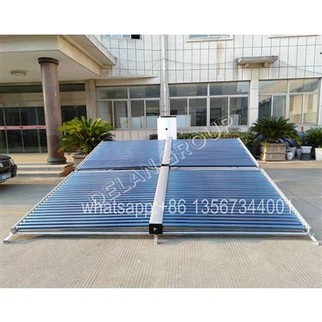
1. Metal pipe: Galvanized pipes are used as Solar water heater pipe. After a few years of use, a lot of rust and dirt will be generated in the pipes. The yellow water flowing out not only pollutes the sanitary ware, but also contains bacteria that grow on the rough inner wall. The rust causes the heavy metal content in the water to be too high, which seriously endangers human health (the country has issued regulations prohibiting it from being used as drinking Solar water heater pipe). Copper pipes have the advantages of corrosion resistance and sterilization, and are the best among Solar water heater pipe. The copper pipe interface has the connection methods of ferrules, welding and self-locking springs. The ferrules have the problem of aging and leakage after a long time. Welding is to use hot melt technology to weld the two connectors to achieve the connection effect. The connection strength is high, and the gas protection of the weld seam of the on-site welding port is difficult to meet the standard, which makes the weld seam easy to rust and directly reduces the service life of the pipeline; the installation quality is highly dependent on the skills of the welding workers, and the quality is difficult to stabilize. The operation is simple and convenient. The construction personnel only need to be familiar with its operation requirements and master it with a little practice. When connecting, the end face of the pipe cut should be perpendicular to the pipe axis, the burrs inside and outside the cut should be cleaned, and the depth to be inserted should be marked on the outside of the front end of the copper pipe with a marker, and then the copper pipe should be inserted into the pipe fitting until the pipe stops. Low installation risk, suitable for various installation environments, reusable, environmentally friendly and energy-saving; no leakage, shockproof, anti-thermal expansion and contraction, safe to use, durable and reliable. One disadvantage of copper pipes is that they conduct heat quickly, so the hot Solar water heater pipe produced by famous copper pipe manufacturers are covered with plastic and foaming agents to prevent heat dissipation. Another disadvantage of copper pipes is that they are expensive. The construction cost of welding is higher, and few families use welded copper pipes for decoration. Stainless steel pipes---------the new favorite Solar water heater pipe for home decoration Stainless steel is safe, hygienic, healthy, and durable, eliminating the problem of plastic pipe pollution, and the price is much cheaper than copper pipes. It is the preferred water pipe material. Stainless steel is not only used in medical, food, beverage, petrochemical and tableware and teapots in our homes, but can also be implanted in the human body, such as artificial steel skeletons and artificial teeth. After decades of application, it has been proven that stainless steel has excellent corrosion resistance, hygiene, no rust, no scaling, no leaching of foreign matter, good self-cleaning properties, long service life, environmental protection, and can be 100% recycled.
2. Plastic pipe: Broadcast editor UPVC pipe is actually a kind of plastic pipe, and the interfaces are generally bonded with glue. UPVC pipes have poor frost resistance and heat resistance. Therefore, hot and cold Solar water heater pipe are rarely used. PVC pipes are suitable for electric wire pipes and sewage pipes. The scientific and technological community has discovered that the chemical additive phthalein that can make PVC softer has a great impact on the kidneys, liver, and testicles in the human body, and can cause cancer. , kidney damage, destroying the body's functional reconstruction system, affecting development (only cold water can be used, hot water is not available, and it is easy to become brittle in winter). PPR pipe water pipe example 2 As a new type of water pipe material, it can be used as both a cold pipe and a hot water pipe. It is becoming a popular material due to its non-toxic, light weight, pressure resistance and corrosion resistance. . Also suitable for hot Solar water heater pipe and even pure drinking Solar water heater pipe. The interface of the PPR pipe uses hot melt technology, and the pipes are completely fused together. Therefore, once the installation and pressure test is passed, there will be no aging and water leakage over time like the aluminum-plastic pipes, and the PPR pipe will not scale. The main disadvantages of PPR Solar water heater pipe are: high temperature resistance and pressure resistance are slightly poor, and the long-term operating temperature cannot exceed 70°C; the linear expansion coefficient is large, and the pipe is easily deformed after hot water is passed through, affecting the appearance; the length of each straight pipe is 4 meters / root, the coil length ranges from 100 meters to 300 meters. And construction at small angles is not possible. If the pipeline is laid over a long distance or there are many corners (small angles), a large number of joints will be used during construction; pipes are cheap but accessories are relatively expensive. PB pipe polybutylene (PB) resin was first synthesized in 1954 by Italian professor G. Natta. Industrial production began in 1964. In 1965, the Austrian Plastics Association presented the first polybutylene (PB) heating pipe system, which made What's exciting is that the system is still running today. In the following 50 years, the application of polybutylene (PB) piping systems has been continuously promoted and used in radiator heating connection piping systems, floor radiant heating systems, and domestic hot and cold water piping systems in buildings. Polybutylene (PB) resin is a high molecular polymer composed of carbon and hydrogen. Compared with traditional materials such as metals and ceramics, polybutylene (PB) resin is easy to process, easy to recycle, has low energy consumption throughout its life cycle, and is environmentally friendly. Friendly materials. From a structural point of view, polybutene (PB) is a linear isotactic semi-crystalline thermoplastic material. It is non-toxic and pollution-free during processing and use, and can be repeatedly heated and formed. Therefore, polybutylene (PB) combines the advantages of hygiene, processability, surface finish, strength, flexibility and connectivity, and achieves a comprehensive balance in physical properties, thermodynamic properties and functionality, thus giving polybutylene The many unique characteristics of butylene (PB) plastic pipes have opened up a broad field of application in the field of fluid delivery systems, especially hot water delivery systems in buildings. PE-RT pipe water pipe example 3PE-RT is heat-resistant polyethylene, which is the English abbreviation of Polyethylene of raised temperature resistance. It is a non-cross-linked polyethylene that can be used in hot Solar water heater pipe. Some people have also highlighted its non-cross-linking properties, call it "high temperature resistant non-cross-linked polyethylene". It is a medium-density polyethylene produced using a special molecular design and synthesis process. It uses the copolymerization method of ethylene and octene to obtain a unique molecular structure by controlling the number and distribution of side chains to improve the durability of PE. Hot sex. Due to the presence of short octene branches, the macromolecules of PE cannot crystallize in one sheet crystal, but run through several crystals, forming a connection between the crystals. It retains the good flexibility and high performance of PE. Thermal conductivity and inertness, while making it better in pressure resistance, this modification method is similar to the common PPR on the market. PE-RT pipes can be used in all usage levels of hot Solar water heater pipe specified in ISO10508. PPH is used for high-density polypropylene pipes in drainage (sewage) pipes, wasteSolar water heater pipe, rainSolar water heater pipe, and exhaust pipes. They should comply with the requirements of DIN53457 (ISO/R1133, ISO/R179, RAL). The installation method should use electric welding sleeves and Construction by docking method. PP-B adopts fusion technology during construction. Therefore, it is also commonly known as hot melt tube. It is non-toxic, lightweight, pressure-resistant and corrosion-resistant. It is becoming a popular material, but it is still relatively rarely used in decoration projects. Generally speaking, this material is suitable not only for cold Solar water heater pipe, but also for hot Solar water heater pipe and even pure drinking Solar water heater pipe. PEX pipe cross-linked polyethylene pipe (PEX) Generally speaking, this material is hot-melt welded. The advantages of PEX pipe: good pressure resistance, nominal pressure 1.25MPa, de16mm burst pressure greater than 6MPa, de20mm burst pressure greater than 5MPa; temperature resistance Wide range: -70-95℃ (short-term 110℃); Resistant to acid and alkali corrosion, can be used to transport a variety of chemical substances; high temperature resistance, excellent low temperature performance; smooth inner and outer walls of the tube, low resistance, no scaling; clean, no pollution, it can save people the pain of using "yellow water" and "rusty water"; using special pipe fittings, it can be installed conveniently and quickly, without tapping, buckling, and welding; it is easy to bend, soft but rigid, saving pipe fittings; weight Light, the pipe length is only 1/10 of galvanized steel pipe; has good heat insulation performance; long service life, at 70℃, working pressure ≤0.8MPa, continuous service life is 50 years. The disadvantage is that it cannot be hot-melt connected, which limits its application scope in HVAC and water supply.
3. Composite pipe: The aluminum-plastic composite pipe is the earliest water supply pipe to replace the cast iron pipe. Its basic composition should be five layers, namely plastic, hot melt adhesive, aluminum alloy, hot melt adhesive, plastic, etc. from the inside to the outside. The aluminum-plastic composite pipe has good thermal insulation performance, and the inner and outer walls are not easy to corrode. Because the inner wall is smooth, the fluid resistance is very small; and because it can be bent at will, it is easy to install and construct. As a water supply pipeline, the aluminum-plastic composite pipe has sufficient strength, but if the lateral force is too large, it will affect the strength, so it is advisable to construct it as an open pipe or bury it in the wall, but it is not advisable to bury it underground. The connection of the aluminum-plastic composite pipe is a ferrule type, so during construction, it is necessary to pass a strict pressure test to check whether the connection is firm. Second, prevent frequent vibration from loosening the ferrule. Third, there should be enough installation space in the length direction to avoid pulling off. Steel-plastic composite pipe Steel-plastic composite pipe, the product is based on seamless steel pipe and welded steel pipe, and the inner wall is coated with high adhesion, anti-corrosion, food-grade hygienic polyethylene powder coating or epoxy resin coating. The galvanized plastic-coated composite steel pipe for water supply is made by pre-treatment, preheating, internal coating, leveling and post-treatment process. It is an upgraded product of traditional galvanized pipe. The product complies with the CJT120-2000 industry standard of the Ministry of Construction. The diameter range is DN15-DN1200. It can be equipped with flanges and pressure grooves. The coating length is 6m, 9m, 12m and indefinite length. The coating wall thickness is between 100 microns and 500 microns, usually 350 microns. Pipeline interface threaded connection, flange connection, clamp connection pre-treatment chemical immersion tank method, physical sandblasting method coating varieties thermoplastic polyethylene powder (PE), thermosetting epoxy resin powder (EP) and other powder coatings .
https://www.delantherma.com/