


Why Choose Us
DELAN Technology is member of DELAN Group, which is established in 2007, being the top manufacturer introduced as domestic thermal supply system, started with solar water heater, heat pump, floor heating manifold system. We specialize in producing Solar Water Heating System, Solar Water Heater for Villa, Two Coils Solar Water Heater, Solar Collector, Compact Solar Water Heater, and other Flat Solar Water Heater.
Products Sell Well
Our products are exporting to Europe, South America, North America, Middle East, South Asia, Africa and other places.
Quick Response
Our commitment is to respond to your inquiries within 24 hours, ensuring that you receive the information and support you require in a timely manner.
Real Factory
Our company was founded in August 2003, being the top manufacturer introduced as thermal supply system in China, started with solar water heater, heat pump, floor heating manifold system.
Rich Experience
We rely on 16 years of work experience to produce high-quality, effective and reasonable heating systems for our customers.
Related Products

It offers the benefits of reduced energy consumption, lower utility bills, and a more sustainable and environmentally friendly alternative to traditional water heating methods.

Solar Hot Water for Room Heating
This solar hot water project is suitable to hotel, office building, schools, industrial area, poultry farms, swimming pool, etc , where need big quantity of hot water consumption.

The heat pipe solar water heaters from Delan Tech is popular worldwide, offer efficient, reliable, and cost-effective solutions for heating water using renewable energy.
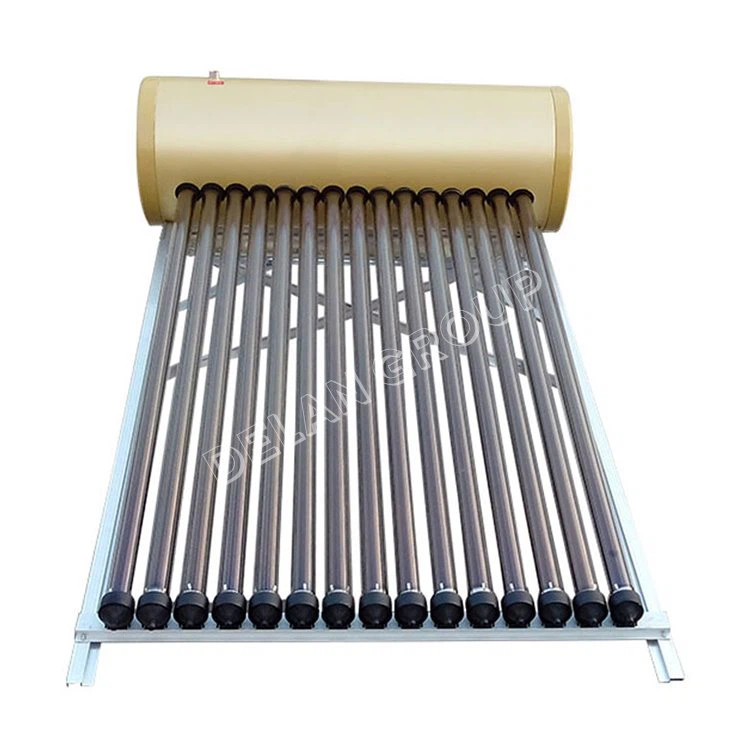
Integrated Pressurized Solar Water Heater
The heat pipe solar water heaters from Delan Tech is popular worldwide, Especially our professionally developed An integrated pressurized solar water heater is a type of solar water heating system that combines both the solar collector and the storage tank in one unit.

Integrated Pressure Solar Water Heater with Heat Pipe
The Pressurized Heat Pipe Solar Water Heaters from Delan Tech is popular worldwide, An integrated pressure solar water heater with heat pipes is a type of solar water heating system that utilizes heat pipes to transfer heat efficiently from the solar collector to the water storage tank.

Solar Master Integrative Pressurized System
This kind of solar water heater is also durable and reliable. The tank of Solar Master integrative pressurized system is made of high-quality stainless steel and is well insulated, which ensures that the water remains hot for an extended period.

Pressurized Solar Water Heaters
The Solar collector and solar plate from Delan Tech is popular worldwide, especially our Pressurized Solar Water Heaters are reliable and efficient solution for harnessing solar energy to heat water.

The effectiveness of a solar water heating system depends on factors such as location, system design, and usage patterns. Consulting with a professional installer can help determine the suitability and potential benefits specific to your situation.

he solar water heater from Delan Tech is popular worldwide, the two-coil solar water heater is a type of solar water heating system that utilizes two separate coils to heat water using solar energy.
What is Solar Hot Water Heater System
Solar water heating system is a device that helps in heating water by using the energy from the SUN. This energy is totally free. Solar energy (sun rays) is used for heating water. Water is easily heated to a temperature of 60-80℃. If you want to know the specifications and prices of Solar Hot Water Heater System, please contact us!
Advantage of Solar Hot Water Heater System
Zero-cost
Ideally, the solar panel uses energy from the sun. This means we do not have to pay a single penny to the power grid for using electricity. Being a renewable source of energy, it is completely free and available each day. All we need to do is figure is how to fine-tune our panel to optimize the performance in cloudy weather. You can contact the best solar water heater suppliers to know more about how solar water heater can be effective in all the seasons.
Ideally, the solar panel uses energy from the sun. This means we do not have to pay a single penny to the power grid for using electricity. Being a renewable source of energy, it is completely free and available each day. All we need to do is figure is how to fine-tune our panel to optimize the performance in cloudy weather. You can contact the best solar water heater suppliers to know more about how solar water heater can be effective in all the seasons.
Efficient
One of the primary reasons solar panel has great outweigh than any other form of energy is that when it comes to heating water is the efficiency, they bring to us. Efficiency here means the solar panels convert almost up to 80% radiation into the heat energy without making use of any external fuels.
Cheap Installation
You will spend a lot less to install a solar panel in comparison to a PV panel. A good way to earn rewards is by transferring the unused unit back to the electricity grid. They are a one-time investment for long term benefits.
Save Space
If there is thought of space for mounting a solar PV panel, we do not need to worry about it as well. If the room is not enough, we can go for a thermal panel.
Save for environment
The world is accepting 'green' and there is no greener energy than solar panels. They have no dependency on fuels, have zero-emission, and lower carbon footprints.
Low Maintenance
Solar water heaters do not require high maintenance. It only demands simple cleaning. As it does not contain any moving parts, there will be no tear and break which would need regular repairing attention. The manufacturer of solar water heater guarantee that it will work for almost 20-25 years but tend to work longer.
Type of Solar Hot Water Heater System
A lot of people believe that the heat pump – isn't a proper 'solar' powered system because it does not use collectors. These people are wrong! Heat pump systems don't need any solar collectors because they use a different type of solar energy. Where 'conventional' solar hot water systems need sun light to heat the water, heat pumps pull solar heat out of the air around us and use this heat to increase your water temperature. Although it sounds unlikely there is actually enough heat in the surrounding air – even on a winter's day – to heat your water right up to boiling!
Heat pump systems do use electricity to remove the heat from the air and transfer it to your water (they are basically air conditioners in "heating-mode"), but they use around 75% less electricity heating your water in this way – compared to a conventional electric water heater.
Here is a typical heat pump system – you can see the similarities to an air conditioner!
This type of system is the most common in Japan, Israel and Australia, which have enjoyed an installed base of millions of residential and commercial systems for the last 30 years. Like the ICS system, the thermosyphon system eliminates the circulation and control system.
However, circulation is provided by the thermosyphoning principle: The hot water storage tank is located higher than the solar collector and circulation flow is induced when the coldest water in the bottom of the storage tank falls by gravity through a circulation line into the bottom of the solar collector panel, where it is heated and rises. Water heated in the solar collector panel rises into a circulation line to a high point in the water storage tank.
Drainback systems have a few more components, but are specifically designed to provide fail-safe operation in climates with frequent freezing during the coldest winter weather. The solar collector and control system are the same as the direct circulation system. However, an antifreeze solution is circulated through the solar collector and back into a heat exchanger in the hot water storage tank. The addition of a heat exchanger adds to the cost of the system and creates some degree of heat transfer energy loss, and this combined with the fact that these systems are typically installed at higher latitudes, where incoming solar radiation is reduced, makes indirect solar water heating less viable than its direct circulation cousin.
Like the direct system, an electronic control system compares the temperature of a sensor located at the solar collector with the temperature of a sensor located in the bottom of the hot water storage tank (where the coldest water is located). When the solar collector temperature is warmer than the water in the bottom of the tank by some predetermined difference (four degrees, for example), the electronic control turns on a small pump However, in the drainback system, the fluid circulating throught the solar collector is separated from the potable water in the hot water storage tank.
Either water or a glycol solution is circulated through the solar collector and a drainback tank. When the pump stops, fluid in the solar collector "drains back" into the drainback tank, leaving the solar collector empty whenever it has no fluid circulating through it. A second circulating pump circulates potable water from the hot water storage tank through a heat exchanger in the drainback tank.
Integral collector storage systems, also called "batch" solar heaters, combine the hot water storage tank and the solar collector surface into a single component, eliminating the need for circulating pumps or automatic control systems. In its most simple implementation, a water storage tank painted black and sitting out in the sunlight is a rudimentary ICS system.
This type of system works best as a preheater for a conventional or tankless water heater. The cold water line that feeds the conventional water heater is diverted and sent first through the ICS solar module. Circulation is provided by utility mains pressure. In other words, when hot water is drawn out for use from the conventional water heater, the storage tank is replenished with solar heated water instead of cold water. This allows the electric or gas heater to work substantially less.
Also called an "active" or "open loop" system, this is the type of system most often installed in the central and southern areas of Florida, and other non-freezing sunbelt climates within the United States.
In the direct system, an electronic control system compares the temperature of a sensor located at the solar collector with the temperature of a sensor located in the bottom of the hot water storage tank (where the coldest water is located). When the solar collector temperature is warmer than the water in the bottom of the tank by some predetermined difference (four degrees, for example), the electronic control turns on a small pump, that draws cold water from the bottom of the hot water storage tank and circulates it through the solar collector. Solar heated water is returned to the top of the tank.
The circulating pump is very small and typically uses about the same amount of electricity as a 100-watt lightbulb. Another version of this system uses a small photovoltaic (solar electric) panel to operate a direct current (DC) circulating pump.
How to Cleaning Inside the Solar Hot Water Heater System
Preparations
Drain the hot water to prevent overflow during cleaning.
Personal experience reminder: If the water temperature is very high at that time, you should add cold water for a while after you put it in the clean water, and then put it out again.
Prepare a pair of gloves with rubber inside.
Clean and disassemble the vacuum heat collection tube.
Take off the dust ring, use a plastic sheet, and gently pry it open to prevent it from touching the heat-collecting glass tube.
Wear anti-skid gloves with rubber on the inner layer, rotate the collector tube back and forth until it moves, and then push it up and down. After the collector tube is fully separated from the sealing ring, push the collector tube upward, and when the lower part is completely separated from the bracket, pull it out again. can.
This step is the key to disassembly, and attention should be paid to
At the beginning, the sealing ring and the collector tube have some scales and rust, and the separation of some tubes is very laborious. It needs to be rotated many times slowly and be patient.
When applying force, apply force slowly based on your feeling to prevent the heat collector tube from being damaged and pay attention to safety.
Clean the internal scale of the heat collection tube and the heat preservation barrel.
Clean the internal scale of the collector tube.
Pour out the water first. Generally, there is some mushy scale on the bottom layer. Gently shake a piece to pour out, and then pour it out with clean water. Generally, it can be cleaned up after three or four times. If there is strong scale, you need to use a professional Cleaning agent, please follow the instructions to use.
The scale cleaning of the heat preservation water tank.
If your insulation bucket can be removed, put it on the ground to clean up faster and cleaner, but if the water inlet pipe is welded by hot-melt pipe, you can clean it slowly with a curved object, and then rinse it with plenty of water.
Check and clean the silicone sealing ring.
This is the key to leakage prevention. Each heat collection tube and the heat preservation barrel have a sealing ring. Remove and clean the scale, especially the contact part of the inner surface and the heat collection tube, to ensure that it is cleaned and replaced if it is broken.
The inner wall of the insulated water tank barrel was cleaned three times, and no attached scale was found, all on the bottom. My personal experience is that the water tank does not need to use a descaling agent. After the scale is formed, it can be washed with water. Of course, according to personal circumstances, if there are attachments inside, you need to use professional cleaning agents.
Install the sealing ring and the heat collection tube.
Reinstall the cleaned seal ring, and patiently reinstall it in place with two hands, check it and install the heat collector.
Prepare a bowl of water, pour some detergent, stir it to make a lubricant, dip the front of the collector tube with detergent water, and then install it, it works well.
After installing the first heat collection tube, check the gap between the insulation bucket and the collection tube to prevent the insulation bucket from deflection. The gap between the upper and lower sides of the collection tube is too large and the final seal is not good.
Finally, add water to check for leaks. After ensuring that there are no leaks, push back the dust ring. Because there is some detergent, it is best to drain the first bucket of water before adding water.
Frequently Asked Questions
Q: Are solar hot water heaters worth it?
Q: Can you run a hot water heater on solar?
Q: How effective is solar water heating?
Q: What is the lifespan of a solar water heater?
Q: Which type of solar water heater is best?
Q: Is solar water heater better than electric?
Q: How much heat does a solar water heater produce?
Q: What is the maximum temperature of hot water through solar water heater?
Q: How big of a solar water heater do I need for 6 people?
Q: What are the two types of solar water heaters?
Q: Which is better heat pump or solar hot water?
Q: What is the difference between active and passive solar water heaters?
Q: Which solar water heater is best tube or panel?
Q: Can solar water heater be repaired?
Q: What is the payback period for solar water heaters?
Hot Tags: solar hot water heater system, China solar hot water heater system manufacturers, suppliers, factory, solar hot water advantage, solar water heating standard, solar hot water reliability, solar water heating project quality assurance plan implementation, solar water heating project return on investment, solar water heating project progress plan tracking


