The first question I hear from homeowners is rarely about collectors, storage tanks, or solar efficiency.
It is usually much simpler.
"Will it still provide enough hot water when my family needs it?"
After working on solar water heating projects for many years, I've learned that this is the question every installer should answer first. People don't buy a solar hot water heater because they want another piece of equipment on the roof. They buy it because they want reliable hot water every day while reducing their electricity or gas bills.
The technology itself is not complicated. What makes the difference is whether the system has been designed for the way people actually use hot water. I've seen small families install oversized systems that never reached their best efficiency, and I've also visited hotels where guests complained about running out of hot water every morning because the storage tank was simply too small.
The equipment wasn't the problem. The design was.
Understanding how a solar hot water heater works before making a purchase is one of the easiest ways to avoid expensive mistakes later.
A Solar Hot Water Heater Doesn't Generate Electricity
One misconception I still come across is that people confuse a solar hot water heater with solar panels.
Although both use sunlight, they work very differently.
Solar photovoltaic panels convert sunlight into electricity.
A solar water heating system converts sunlight directly into heat.
That difference makes a solar thermal system one of the most efficient renewable energy solutions available for domestic hot water production. Instead of producing electricity first and then heating water, the collector transfers solar energy directly into the water, reducing energy losses throughout the process.
For homeowners, that simply means lower running costs and less dependence on conventional energy.
How Does a Solar Hot Water Heater Work?
Every solar hot water system follows the same basic process.
The solar collector absorbs solar radiation throughout the day. The heat is transferred to water or a heat-transfer fluid, depending on the system design. The heated water is then stored inside an insulated hot water storage tank, ready whenever someone turns on a shower, faucet, or washing machine.
People often imagine that the collector has to produce hot water exactly when they need it.
That's not how the system works.
The collector stores energy during the day, while the insulated storage tank keeps the water hot for later use. In a well-designed system, the storage tank is just as important as the collector itself.
I remember visiting a customer who believed his collector had failed because the water temperature dropped after several family members showered one after another.
The collector was working perfectly.
The real issue was that six people were sharing a 150-liter storage tank designed for three.
No collector can compensate for a storage tank that is too small.
The Two Main Types of Solar Hot Water Heater
Most residential solar hot water heaters use one of two collector technologies.
- Evacuated Tube Solar Water Heater
This is the system many people recognize immediately.
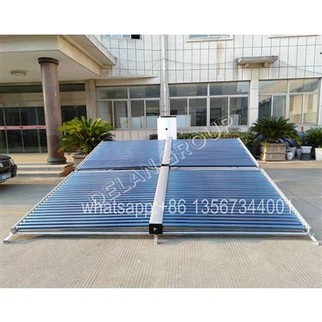
Each collector contains multiple vacuum glass tubes that dramatically reduce heat loss. Because of the vacuum insulation, evacuated tube solar water heaters perform particularly well during winter and in colder climates.
We've installed these systems in mountain regions where winter temperatures regularly fall below freezing. Even under those conditions, the collectors continued producing useful hot water whenever sunlight was available.
That is why evacuated tube systems are often recommended for homes with significant seasonal temperature changes.
- Flat Plate Solar Water Heater
The second option is the flat plate solar water heater.
Instead of glass tubes, these collectors use an insulated absorber plate beneath tempered glass.
Flat plate collectors are widely used in regions with stable sunshine and relatively mild winters. They are mechanically robust, simple to maintain, and perform very well in commercial applications such as hotels, schools, and apartment buildings.
There is no universal winner between the two systems.
The right choice depends on local climate, available installation space, daily hot water demand, and project budget.
- Pressurized or Non-Pressurized?
This is another decision that many buyers overlook.
A pressurized solar hot water heater supplies water at pressure similar to a conventional household water heater. Multiple bathrooms can operate simultaneously without a noticeable drop in water pressure.
A non-pressure solar water heater has a simpler structure and lower initial cost, making it suitable for smaller homes or locations where water pressure is already limited.
In recent years, most of our residential customers have chosen pressurized systems because families expect the same shower experience they get from traditional water heaters.
Comfort matters just as much as energy savings.
What Are the Biggest Benefits?
The most obvious benefit is reduced energy consumption.
Once the system is installed, sunlight becomes the primary energy source for heating water. In regions with good solar resources, a solar hot water heater can provide a significant portion of a household's annual hot water demand.
Another advantage is predictable operating costs.
Electricity prices continue to rise in many countries. Solar energy does not.
A properly installed solar water heater also has relatively low maintenance requirements. Routine inspections, occasional cleaning of the collectors, and checking valves and insulation are usually sufficient to keep the system operating efficiently.
Many systems continue performing reliably for well over fifteen years.
Choosing the Right System
When customers ask me which solar hot water heater is the best, I usually answer with another question.
"How many people are taking showers between seven and nine o'clock every morning?"
That question tells me far more than asking about collector brands.
The right system depends on several practical factors:
- Daily hot water consumption
- Number of family members
- Local climate
- Roof orientation
- Available installation space
- Water pressure requirements
Selecting equipment based only on price often leads to disappointment.
A slightly larger collector or a better-insulated storage tank may cost more initially but can significantly improve long-term system performance.
Common Mistakes Buyers Make
Over the years, I've noticed the same mistakes appearing again and again.
The first is buying the system with the lowest price instead of the one that matches actual hot water demand.
The second is ignoring installation conditions. Even the best solar collector cannot perform properly if it spends half the day in the shade.
The third is assuming every system works the same in every climate.
A system performing perfectly in southern Spain may produce very different results in northern Europe.
Good equipment is important.
Correct system design is even more important.
Final Thoughts
A solar hot water heater is no longer a niche renewable energy product. It has become a practical and proven solution for homeowners and commercial buildings looking to reduce energy costs while maintaining a reliable supply of hot water.
From our experience, the best-performing projects are not necessarily the ones using the most expensive equipment. They are the ones where the solar water heating system has been designed around the customer's actual water consumption, climate conditions, and installation environment.
At DELAN Technology Co., Ltd., we work with customers across residential, commercial, and project-based applications. Whether the requirement is a domestic solar water heater, a pressurized solar hot water system, or a larger commercial installation, we believe successful projects always begin with proper system selection rather than simply choosing a product. That approach helps our customers achieve better heating performance, lower operating costs, and reliable hot water for many years.