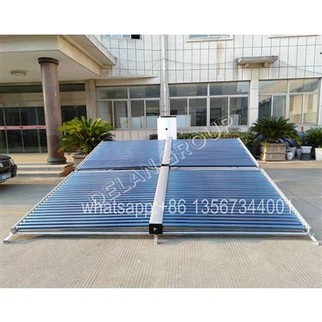
One of the most expensive solar hot water systems I've ever seen wasn't the best one.
It was simply the biggest.
The homeowner believed that buying a larger system would automatically give him more hot water and save more electricity. Six months later, he called us because the return on investment was far below what he expected.
Nothing was wrong with the equipment.
The collectors worked exactly as designed.
The storage tank held enough hot water.
The problem was much simpler.
There were only two people living in the house.
They rarely used more than 100 liters of hot water a day, yet they had installed a system designed for a family of six.
They had spent more money than necessary, occupied more roof space than required, and increased heat loss from a storage tank that was rarely fully utilized.
That project reminded me of something I still tell customers today.
The best solar hot water heater is not the largest one. It's the one that matches how you actually use hot water.
Start with Your Daily Hot Water Demand
When people begin comparing different solar hot water heaters, they usually ask about collector size first.
I rarely answer that question immediately.
Instead, I ask something different.
How many people live in the building?
How many bathrooms are used at the same time?
Is everyone taking showers in the evening, or are they spread throughout the day?
Those answers determine almost everything.
A family of three generally has very different hot water requirements than a guesthouse with ten occupied rooms.
Likewise, a restaurant that only needs hot water for cleaning is completely different from a hotel where hundreds of showers may be taken every day.
The system should always be designed around water consumption-not around the biggest collector you can afford.
Your Climate Matters More Than Most People Think
A mistake I often see online is people recommending exactly the same solar water heating system regardless of where it will be installed.
Real projects don't work that way.
We once supplied nearly identical systems to customers in Australia and Northern Europe.
Both systems used high-quality collectors.
Both were installed correctly.
Yet their annual performance was completely different because sunlight conditions were different.
In warmer regions with long sunny days, even a relatively compact solar hot water heater can provide excellent performance throughout most of the year.
In colder climates, winter sunshine becomes much more valuable than summer sunshine.
That is why evacuated tube solar water heaters are often recommended for areas with freezing temperatures. Their vacuum insulation helps reduce heat loss when the outside air becomes much colder.
On the other hand, flat plate solar water heaters perform exceptionally well in regions with stable sunshine and mild winters.
There isn't a universally better collector.
There is only the collector that suits your climate.
Don't Choose the Storage Tank by Guesswork
If I had to point to the component people underestimate most, it would probably be the storage tank.
Many buyers think only about collector efficiency.
The collector heats the water.
The tank keeps it hot.
Without enough storage, you'll run out of hot water even if the collector performs perfectly.
With too much storage, you'll spend more money than necessary and increase standing heat loss.
For residential applications, proper tank sizing usually depends on:
Family size
Daily shower habits
Kitchen usage
Seasonal demand
Commercial projects are even more complicated.
Hotels, schools, hospitals and factories all have completely different hot water consumption patterns.
This is one reason experienced system designers always ask detailed questions before recommending equipment.
Should You Choose a Pressurized System?
This question comes up almost every week.
From a user's perspective, the answer is actually very simple.
If you expect your shower to feel exactly like it does with a conventional electric water heater, a pressurized solar hot water heater is usually the better choice.
Pressurized systems deliver stable water pressure throughout the house and allow multiple outlets to operate simultaneously.
A non-pressure solar water heater still has its place.
It is economical.
It has a simpler structure.
Maintenance is straightforward.
For small homes, rural properties or areas without stable municipal water pressure, it remains a practical solution.
Again, neither option is automatically better.
It depends on how the building is used.
Think Beyond the Purchase Price
Another mistake I often see is comparing systems only by equipment cost.
That's understandable.
Everyone has a budget.
But the purchase price is only one part of the investment.
A cheaper system that requires frequent electric backup may cost far more to operate over the next ten years than a slightly more expensive system with better collector efficiency.
I've seen customers focus on saving a few hundred dollars during installation while ignoring thousands of dollars in future energy costs.
The goal isn't buying the cheapest solar hot water system.
The goal is buying the one with the lowest lifetime operating cost.
Those are two very different things.
Don't Ignore Installation Conditions
One of the easiest ways to reduce system performance is poor installation.
Even the best solar collector cannot compensate for poor positioning.
Before choosing equipment, always consider:
Roof orientation
Available installation area
Potential shading from nearby buildings
Future tree growth
Roof load capacity
I've seen perfectly good collectors installed where they were shaded every afternoon.
The equipment wasn't faulty.
The location was.
A proper site assessment often improves system performance more than upgrading to a more expensive collector.
My Advice After Years of Solar Projects
If someone asked me today how to choose the right solar hot water heater, I wouldn't start with brands.
I wouldn't start with collector size.
I certainly wouldn't start with price.
I'd start with one question.
How do you actually use hot water every day?
Once you know that, almost every other decision becomes easier.
The collector type becomes clearer.
The storage tank size makes sense.
The choice between pressurized and non-pressure systems becomes obvious.
At DELAN Technology Co., Ltd., we've found that the most successful projects always begin with understanding the application rather than selling a standard configuration. Whether the installation is for a private home, a hotel, a school or a commercial building, the best-performing solar hot water heater is the one designed around real usage, local climate and long-term operating efficiency-not simply the one with the biggest specifications.