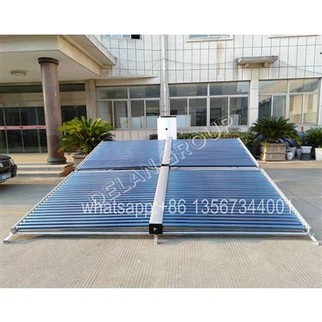
The system has good thermal insulation performance and large heat storage capacity. The thermal insulation water tank has a water storage function, which can meet the needs of a large number of people for centralized use of hot water, and can also be used as an emergency water source when the water supply is cut off. The solar water heater system is fully automatic and static, does not require special supervision, is noise-free, pollution-free, has no leakage, fire, poisoning and other dangers, is safe and reliable, and is environmentally friendly and energy-saving, which benefits the country and the people. It has sewage purification function, and the water source is clean and pollution-free. The vacuum tube solar water heater has good thermal insulation performance and strong antifreeze ability. Large-area installation has a heat insulation effect on the floor. my country has a vast territory and very rich solar energy resources. Except for some local areas (such as Sichuan and Guizhou) that are not suitable for solar energy utilization, most areas of my country are suitable for solar energy utilization. It is estimated that the total amount of solar radiation received by China's land each year is equivalent to 2400 billion tons of standard coal, and the average annual radiation is about 5900 megajoules/square meter. The main characteristics of my country's solar energy resource distribution are: the high-value center and the low-value center of solar energy are both located in the area of 22°~35° north latitude, the Qinghai-Tibet Plateau is the high-value center, and the Sichuan Basin is the low-value center. The average altitude of the Qinghai-Tibet Plateau is above 4,000 meters. The atmosphere is thin and clean, with good transparency, low latitude and long sunshine time. For example, Lhasa, known as the "Sunshine City", has an average annual sunshine time of 3,005.7 hours from 1961 to 1970, a relative sunshine of 68%, and a total solar radiation of 8,160 MJ/m2·a, which is higher than other provinces and regions at the same latitude in the country. The Sichuan Basin has a lot of rain and fog, and few sunny days. For example, the annual average sunshine hours in Chengdu are only 1,152.2 hours, with a relative sunshine of 26%. The total annual solar radiation is higher in the western region than in the eastern region, and except for the two autonomous regions of Tibet and Xinjiang, it is basically lower in the south than in the north; because most areas in the south are cloudy, foggy and rainy, the distribution of solar energy in the 30° to 40° north latitude area is contrary to the general law that solar energy changes with latitude. Solar energy does not decrease with increasing latitude, but increases with increasing latitude. During the "Eighth Five-Year Plan" period, relevant research in my country divided my country's solar energy resources into five categories (Table 1-3). Category I, II and III regions have annual sunshine hours greater than 2000h and total radiation of 5000MJ/m2·a. They are regions with rich or relatively rich solar energy resources in my country. They are large in area, accounting for more than 2/3 of the country's total area, and have good conditions for utilizing solar energy. Although the solar energy resource conditions in category IV and V regions are poor, they still have certain utilization value. Table 1-4 shows the total annual radiation of some cities in the world. As can be seen from the following two tables, even in areas with poor solar energy resources in my country, the total annual radiation is close to Tokyo, and higher than London and Hamburg, cities in the world that have better solar energy utilization. It can be seen that my country has good conditions for utilizing solar energy and should vigorously develop solar energy resources.
https://www.delantherma.com/