Look, I've been managing renewable energy water heating projects for over 15 years, and I can tell you the most common complaint I hear from homeowners: "My solar geyser ran out of hot water," or "My system froze and burst last winter."
When I go out to inspect these systems, 9 times out of 10, the equipment isn't defective. The problem is that the system was sized and specified completely wrong for that specific house.
Choosing a residential solar water heater isn't just about picking the shiny tank with the biggest number on the box. It's a balancing act between solar water heater sizing (your family's actual draw profile) and the local climate (what the weather throws at your roof).
Let's skip the marketing brochures. Here is how we actually engineer and specify a solar geyser at DELAN Technology Co., Ltd. to ensure it works flawlessly in the real world.
1. The Math Behind the Magic: Sizing by Family Size
The biggest mistake buyers make is guessing their solar geyser capacity. If you buy a 150-liter tank for a family of five, you're going to be taking cold showers. If you buy a 300-liter tank for a couple, you're wasting money and risking summer stagnation.
The "Real World" Sizing Rule
The industry standard rule of thumb is roughly 50 liters of tank capacity per person. But as an engineer, I don't use standard rules; I use actual habits.
The Quick-Shower Family (4 people, 5-min showers): A 150L to 200L tank is usually plenty.
The "Marathon Shower" or Bath Family (4 people, loves filling the tub): You need to jump up to a 250L or 300L tank. Baths consume massive amounts of hot water (often 80-100 liters per bath).
The Multi-Generational Home (6+ people): You are now in commercial solar water heating territory. You either need a massive 500L+ residential tank, or we design a cascaded system with two smaller tanks.
The Engineering Reality: Don't just size for the number of people; size for the behavior of the people. If your family uses the dishwasher and washing machine on hot cycles during the day, your solar geyser is recovering that hot water. If everyone showers back-to-back at 6:00 AM, you need a larger tank to hold the thermal reserve.
2. Climate is King: Choosing the Right Collector Technology
Once we know how much hot water you need (the tank), we have to figure out how to heat it efficiently in your specific weather (the collectors on the roof). This is where the solar thermal system design gets critical.
Scenario A: Mild, Sunny, and Frost-Free Climates
If you live in a coastal area or a tropical region where temperatures rarely drop below freezing, I always recommend flat plate solar collectors.
Why? They are highly efficient in direct sunlight, incredibly durable, and aesthetically pleasing because they sit flush against the roof. They are the workhorses of warm climates.
Scenario B: Freezing Winters or Highly Cloudy Regions
If you experience sub-zero temperatures, or you live in an area with frequent cloud cover, standard flat plates will fail. You need a solar geyser for cold climate performance.
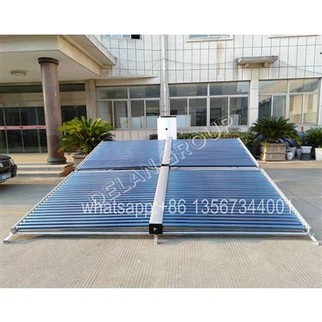
The Fix: We switch to evacuated tube collectors. The vacuum inside each tube acts like a thermos, meaning even if it's -10°C outside and the tube is freezing cold, the inner glass can be boiling hot. They perform brilliantly in low-light and freezing conditions.
The Backup: In extreme cold climates, I never spec a solar-only system. We integrate a heat pump backup for solar or an electric element inside the tank. When the sun hides for three days in January, the heat pump kicks in to ensure you still have hot water without bankrupting you on electricity.
3. The Roof Reality: Mounting, Wind, and Aesthetics
Here is a secret most salespeople won't tell you: the tank and the collectors are only 60% of the project. The other 40% is how it attaches to your house.
I've seen million-dollar homes ruined by ugly, poorly angled tanks, and I've seen arrays blown off roofs in high winds because the contractor used cheap, residential-grade racking.
The DELAN Approach to Installation
When we handle a solar water heater installation, we don't just bolt metal to tiles. We engineer custom solar mounting structures tailored to your roof's specific pitch and wind-load zone.
For high-end residential projects, we take it a step further. We integrate Building Integrated Photovoltaics (BIPV) design principles into our thermal mounts. This means the collectors sit ultra-flush, the piping is hidden, and the system looks like it was architecturally designed into the roof, rather than bolted on as an ugly afterthought.
4. Real-World Engineering: How We Solved It in the Field
Let me give you two real examples of how getting the sizing and climate right changes everything.
Project 1: The Mountain Cabin (Freezing Climate, Family of 4)
The Problem: The client bought a cheap, direct-circulation flat plate system online. First winter, the water inside the panels froze, expanded, and cracked the manifolds. Total system failure.
The DELAN Fix: We replaced it with a split-system solar geyser utilizing high-efficiency evacuated tube collectors. We used a glycol heat-exchange loop so the actual water never goes on the roof, and we integrated a smart heat pump backup for solar in the basement.
The Result: The system survived -15°C winters without a scratch, and the heat pump kept the water at 60°C even during a week-long blizzard.
Project 2: The Modern Coastal Villa (Sunny Climate, Family of 3)
The Problem: The homeowners wanted a solar geyser, but the architect strictly forbade anything that protruded above the roofline or looked "industrial."
The DELAN Fix: We specified ultra-low-profile flat plate solar collectors. Instead of standard tilting racks, we fabricated custom solar mounting structures that followed the exact 15-degree pitch of their standing-seam metal roof. The 200L tank was neatly hidden in a ventilated outdoor utility closet.
The Result: The architect was thrilled, the HOA approved it instantly, and the family of 3 gets 100% of their hot water from the sun.
5. The Project Manager's Checklist Before You Buy
Before you sign the contract for your new system, run through this checklist:
1. Calculate Peak Demand: Count the number of bathrooms. If you have 3+ bathrooms and a deep soaking tub, upsizing the solar geyser capacity is non-negotiable.
2. Check the Winter Lows: If your local temperature drops below 0°C (32°F), you must specify freeze-protected collectors (evacuated tubes or glycol flat plates).
3. Evaluate the Roof: Is your roof shaded by trees between 10 AM and 3 PM? If yes, solar isn't the right choice, or you need to look at a ground-mount.
4. Ask About the Racking: Ask your installer specifically what solar mounting structures they are using. If they can't answer, walk away.
Stop Guessing: Partner with DELAN Technology Co., Ltd.
Choosing the right solar geyser is about matching the physics of your home with the reality of your climate. It's not a one-size-fits-all product; it's a custom solar heating solutions project.
At DELAN Technology Co., Ltd., we don't just drop a box on your driveway. We engineer the entire system-from calculating your exact family hot water draw profile, to selecting the perfect collector technology for your climate, to fabricating the heavy-duty solar mounting structures that keep it all safe and beautiful.
Ready to get your sizing and climate strategy right the first time?
Contact the engineering team at DELAN Technology Co., Ltd. today. Let's look at your roof, your habits, and your budget, and design a system that actually works.